A step competition your team will actually join
Your company gets its own private leaderboard. Steps come off the phone people already carry, a new week starts every Monday, and nobody on your side has to run it. Hand out a work code and you’re done.
+0
Extra steps a day from competition, in a 602-person trial
0.0
Fewer workdays missed per year by active employees
0%
Less likely to report burnout when wellbeing feels supported
0.0%
Of U.S. health spending tied to too little activity
Sources cited in full below.
What you're getting
You set it up once. Then it runs without you.
A leaderboard that's only yours — Private to your company.
Nobody has to run it — No admin work, ever.
The incentive is yours to set — You decide what's at stake.
Nothing to buy or wear — No hardware to distribute.
Steps. That's the whole data set — We read step counts, nothing else.
A bigger race, always running — A global board too, opt-out anytime.
A leaderboard that's only yours
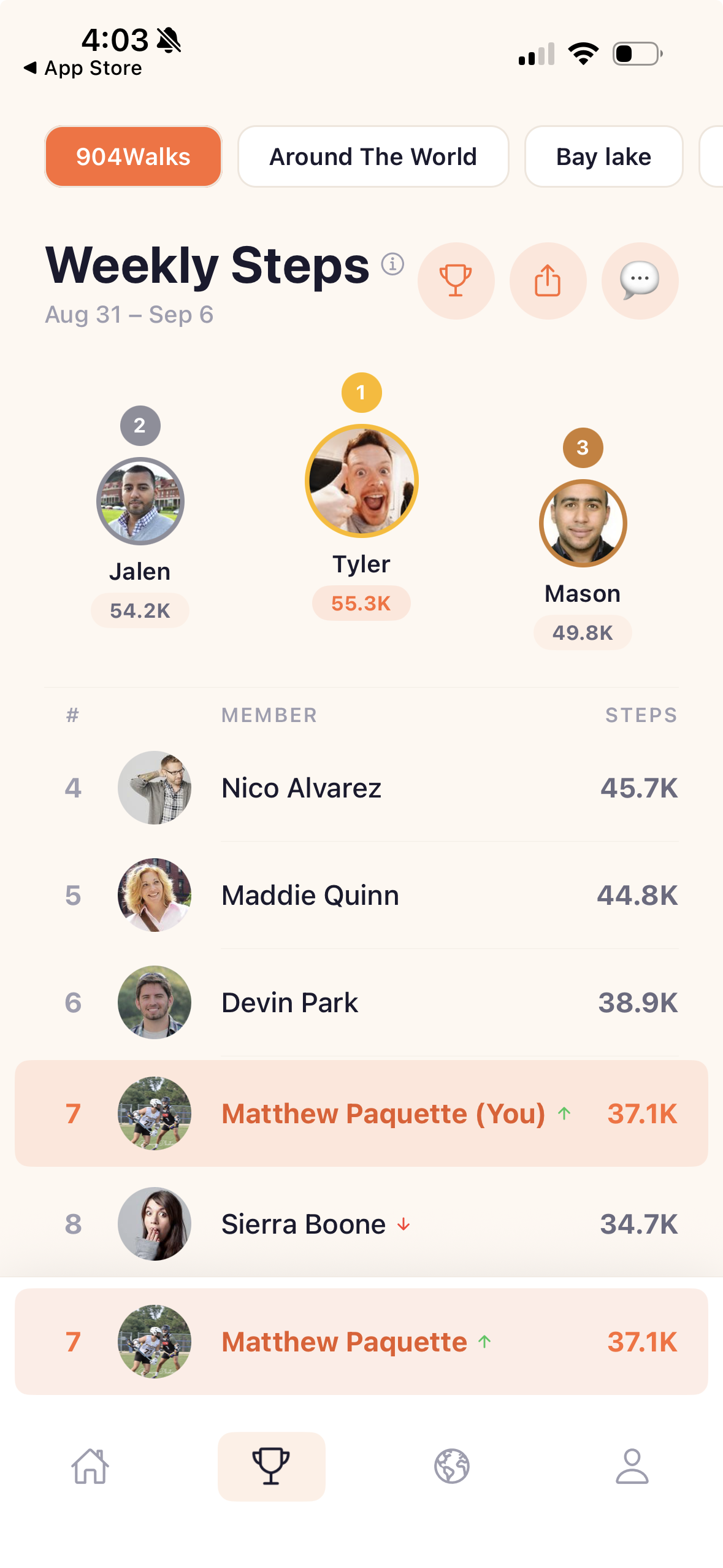
Your company gets a private group. Only people who redeem your work code can see it or appear on it. Names, faces, weekly totals, and who moved up since yesterday.
Nobody has to run it
The week opens Monday and closes Sunday, results post themselves, and the next one starts. There's no dashboard to check, no reminders to send, and no coordinator to appoint.
The incentive is yours to set
We rank everyone honestly and publish the results. What the winner gets is entirely your call — a half-day, a gift card, a charity donation, or nothing but the top spot.
Nothing to buy or wear
Steps come from Apple Health, Google Fit, or Fitbit — whatever your people already use. No pedometers to order, no devices to hand out, no inventory to chase down when someone leaves.
Steps. That's the whole data set
We read a daily step count and nothing else. No heart rate, no sleep, no location, no health conditions. Employees see exactly what their coworkers see, and it's a number.
A bigger race, always running
Alongside the company board, everyone sits on a worldwide leaderboard. Someone who'll never crack your top three still has a reason to check in — and can opt out of it entirely.
Inside the app
It looks like a game, not an HR portal
That difference is most of why people keep opening it.
Your company board
Everyone can see where they stand
A weekly podium at the top, then the full ranked list. Each person's own row stays pinned to the bottom of the screen wherever they are on it, with an arrow showing whether they moved up or down since yesterday.
The daily screen
Steps today, and how far off the goal
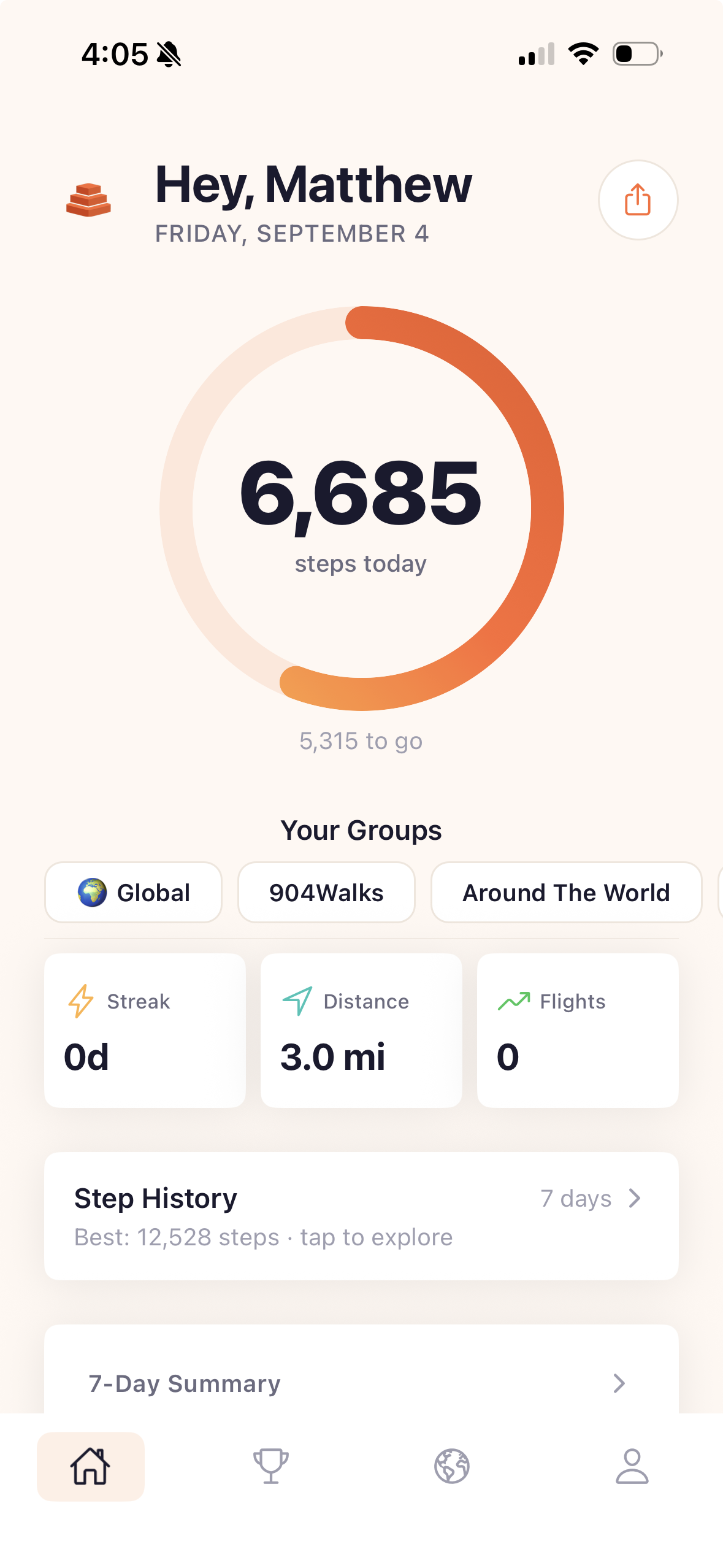
This is the screen most people open and close in four seconds. Today's count, what's left to hit the goal, current streak, and a shortcut into every group they're in — including yours.
The monthly route
Every month is a different walk
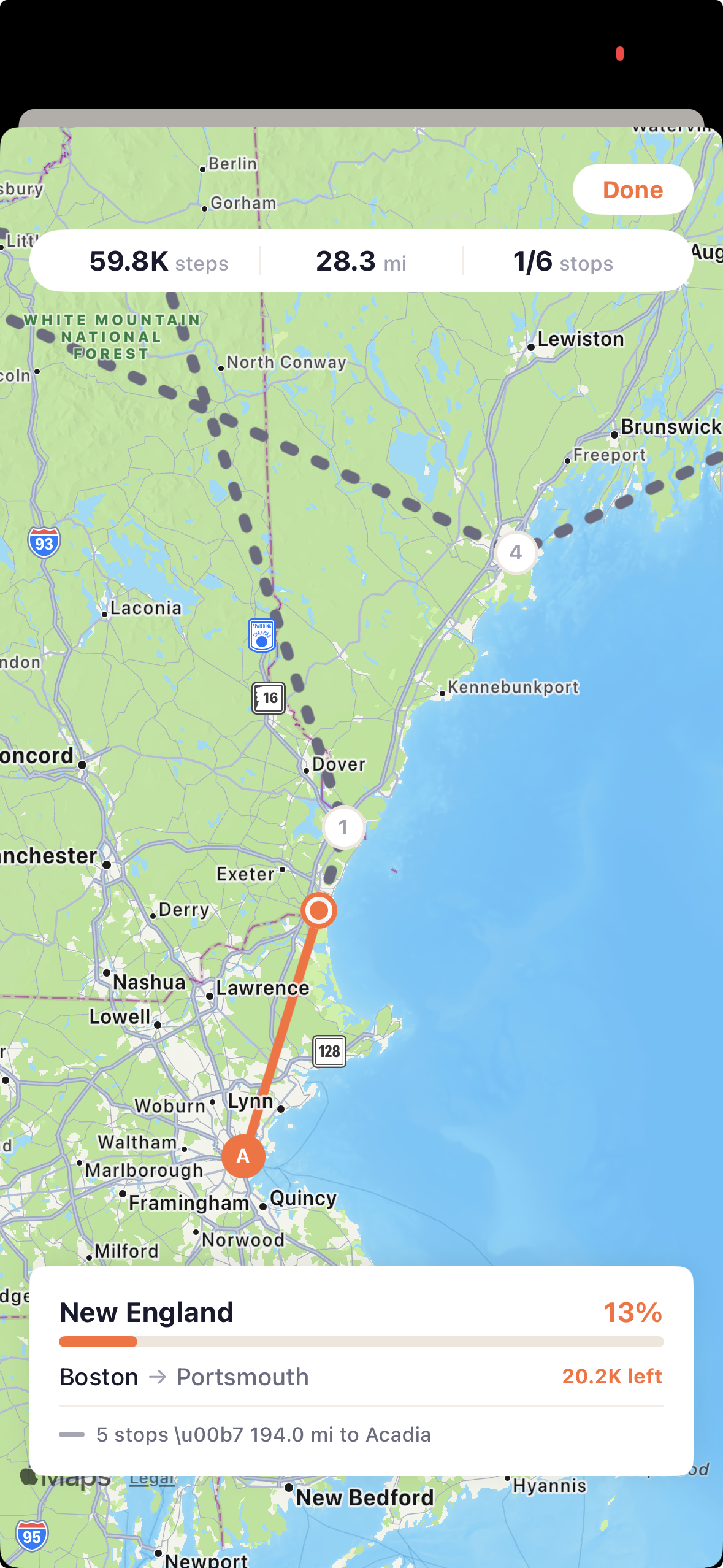
Everyday steps move a pin along a real route — Boston up to Acadia, Route 66, the California coast. Twelve of them, one a month, each with its own stops to reach along the way. It gives the daily count somewhere to go that isn't a leaderboard.
Personal history
Thirty days, one glance
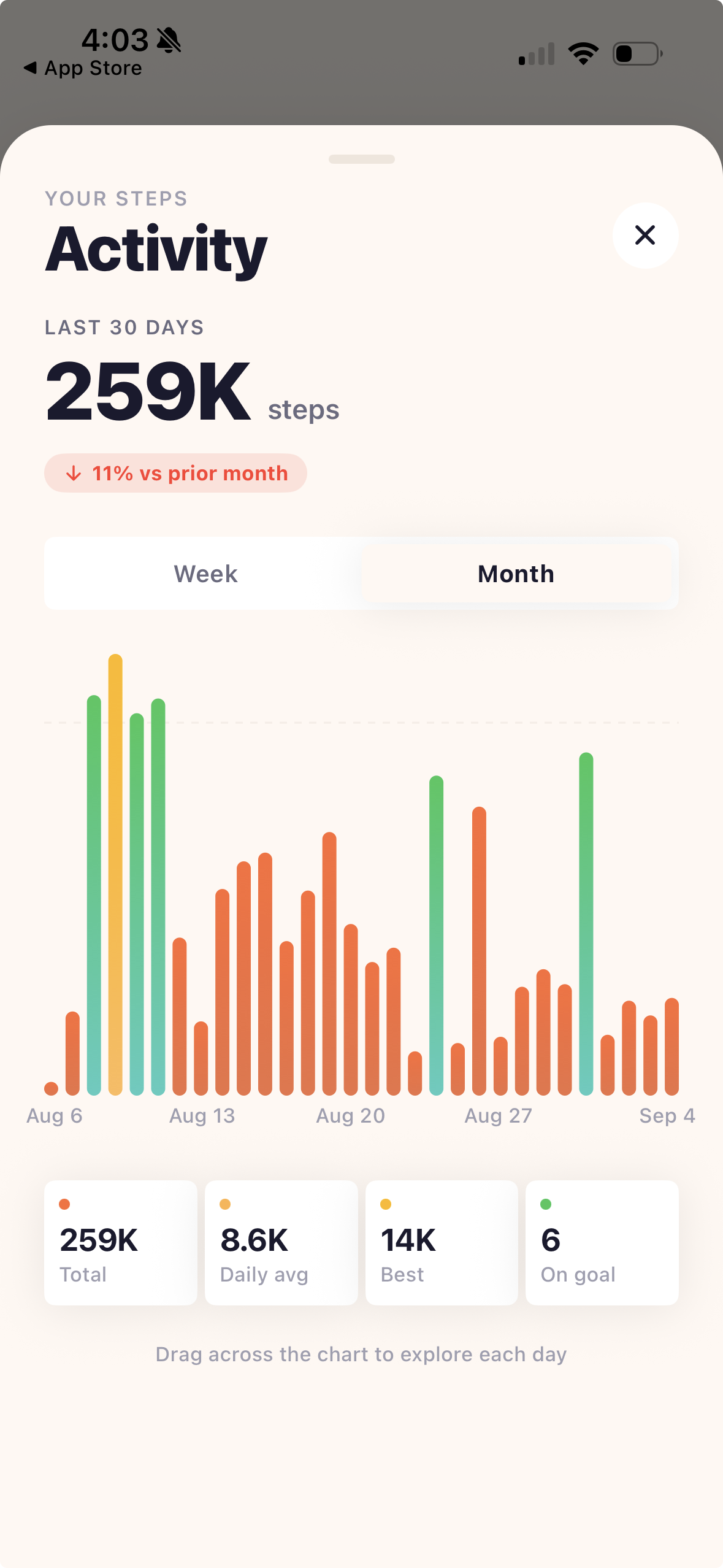
Every day of the last month, with the days they hit goal marked in green. Total, daily average, best day, days on goal. It's the part that turns one good week into a habit worth defending.
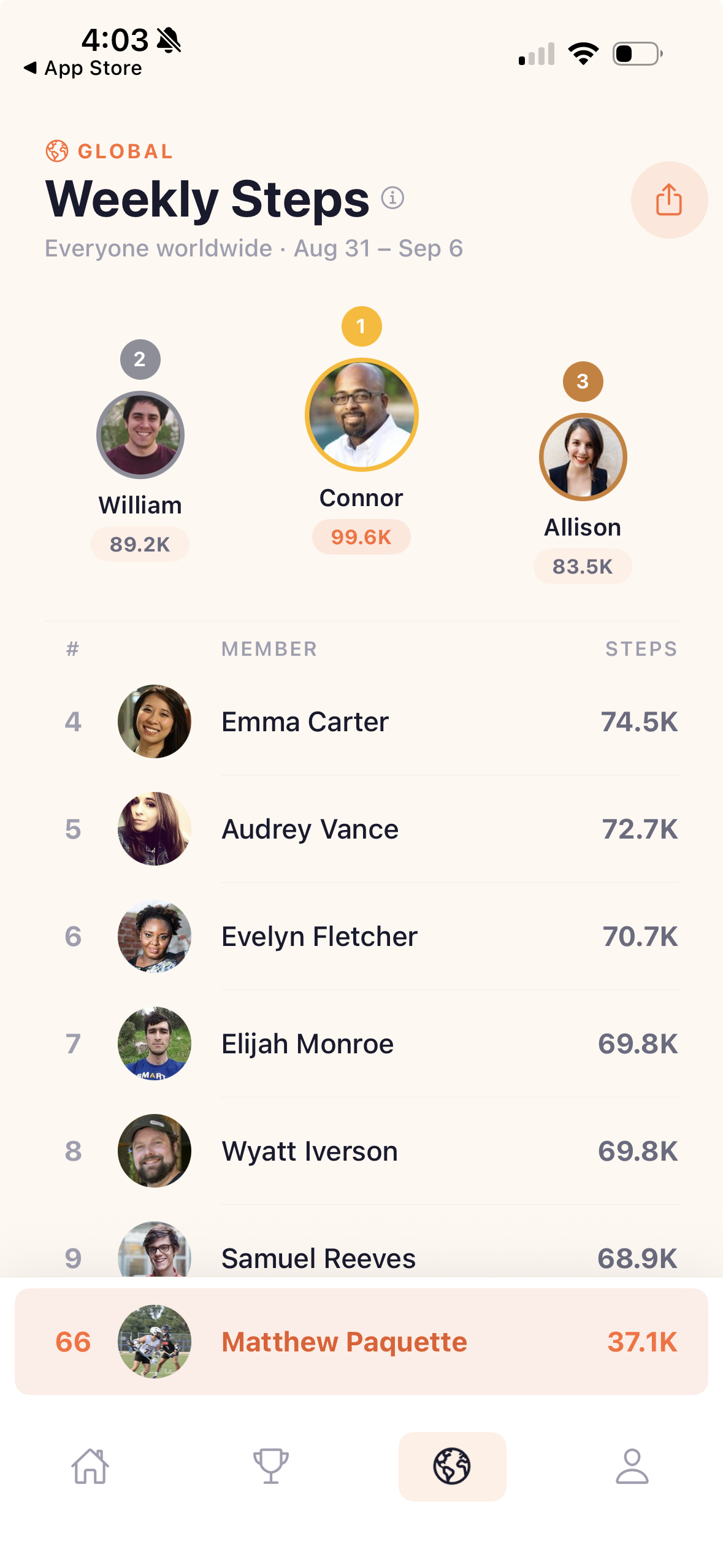
The world board
There's always someone ahead
Alongside the company board, everyone competes on a worldwide leaderboard. It keeps the people who won't win at work engaged anyway — and anyone who'd rather not appear on it can switch it off.
Rolling it out
Three steps, and none of them are yours to repeat.
01
Tell us who's in
One conversation about your company name and roughly how many people. We build your private group and issue a work code. Nothing to install on your end.
02
Send one email
Employees download StepRank, type the work code, and allow Apple Health or Google Fit. It takes about a minute, and the code is the only thing they need from you.
03
Let Monday do the rest
The week opens on its own and closes Sunday night with a ranked result. Then a new one starts. If you want to attach a prize, that's the only decision left.
The research
Somebody already ran the study.
Step competitions at work have been measured properly, repeatedly, in randomized trials and in programs with tens of thousands of employees. Every one below opens the source.

Competition beat encouragement, and it beat teamwork
602 adults, 24 weeks, four groups. The head-to-head leaderboard added the most steps — and was the only format still clearly ahead three months after the game ended.
- +920 steps/day vs. control
- +569 still holding at 12 weeks

Four weeks of a workplace challenge moved stress, not just steps
2,042 employees took part. Daily steps rose by a third, self-rated productivity went up, and perceived stress fell on a validated scale.
- 9.7K → 13.1K steps/day
- Stress 16.7 → 15.3 (p < 0.0001)
It holds up across 10,183 people and four straight years
The same national workplace challenge, measured every year from 2015 to 2018. Steps rose against week one in every single year of delivery.
- +906 steps/day by week 8
- ≈63 extra active minutes a week

A year later, the people who needed it most were still better off
716 employees in sedentary jobs across ten workplaces, followed for twelve months. The gains concentrated in the group that started most distressed.
- −6.5 K10 points at 12 months
- −1.8 for those hitting 10K a day

Active employees simply miss fewer days
The CDC's guide for employers puts the gap at just over four workdays a year, and notes that inactive employees take more sick leave on top of it.
- 4.1 fewer workdays missed per year

One in nine health care dollars traces back to inactivity
A CDC-led analysis that merged national physical activity data with national spending data. For a self-insured employer, that share stops being abstract.
- 11.1% of U.S. health spending (95% CI 7.3–14.9)
Why it works as a benefit
The competition is the incentive.
You don’t have to talk anyone into checking a leaderboard. StepRank gives your team a reason to move that resets every Monday and asks nothing of them beyond the phone they already carry.
- People actually open it
- A rank that changes every day is its own reminder.
- Setup is about a minute
- Download, enter the work code, allow health access. Done.
- You can see it working
- Participation shows up on the board from day one.
- Add a prize, or don't
- The ranking does the work either way.
New — daily quests
Walk the day. Win the month.
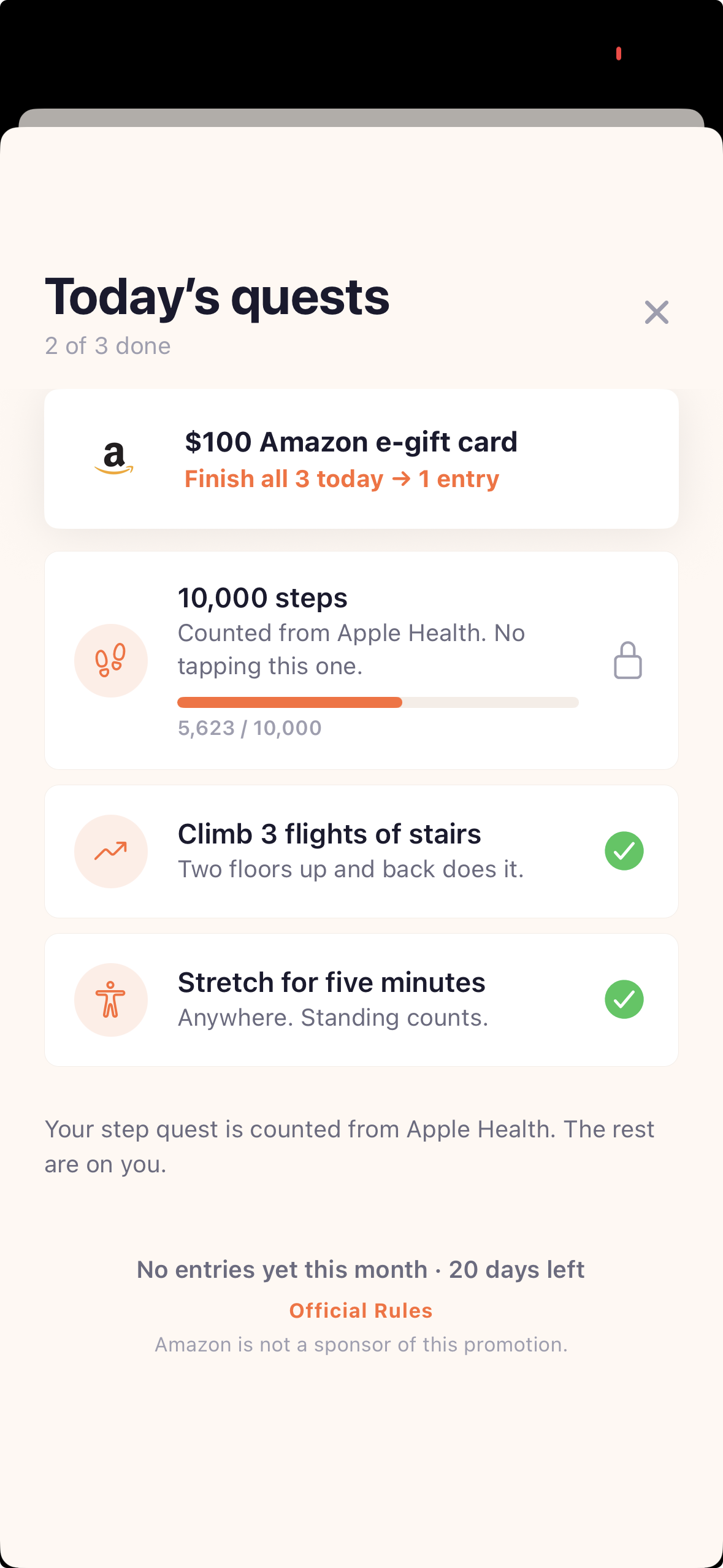
Every morning StepRank sets two or three quests. Finish them and the day puts one entry into that month’s drawing for a chance to win a prize. One winner, every month, drawn from everyone who walked.
Three quests, and one of them can’t be faked
- One quest is verified
- Your step target is read from Apple Health or Health Connect. There is no button to press on that one, which is the whole reason the rest can be trusted on your word.
- The others are small
- Vegetables with a meal. Five minutes of stretching. Three flights of stairs. Things a person can actually do on a Tuesday.
- Everyone gets the same list
- The quests are identical for every user in the world that day, so nobody draws an easier month than anybody else.
How entries add up
Twenty days walked.
Twenty chances.
Every daily challenge you finish is one entry in that month’s drawing.
from one ordinary month
The prize changes month to month and is named in the app from the first — Amazon, Walmart, Target, Nike, Starbucks, Dick's Sporting Goods and more.
No purchase necessary · 18+ · Void where prohibited
A subscription is not required to enter and does not affect the odds. Brands shown are examples, not a guarantee of any particular prize, and are not sponsors of this promotion, which is not affiliated with Apple or Google. Full Official Rules are in the app.
FAQ
What companies ask us first
See it with your company’s name on it.
Tell us roughly how many people you have and we’ll show you the board your team would be walking on. It’s a short conversation.
Or just email contact@risodevelopment.com